

Why Node.js is Perfect for Building Fast Web Applications
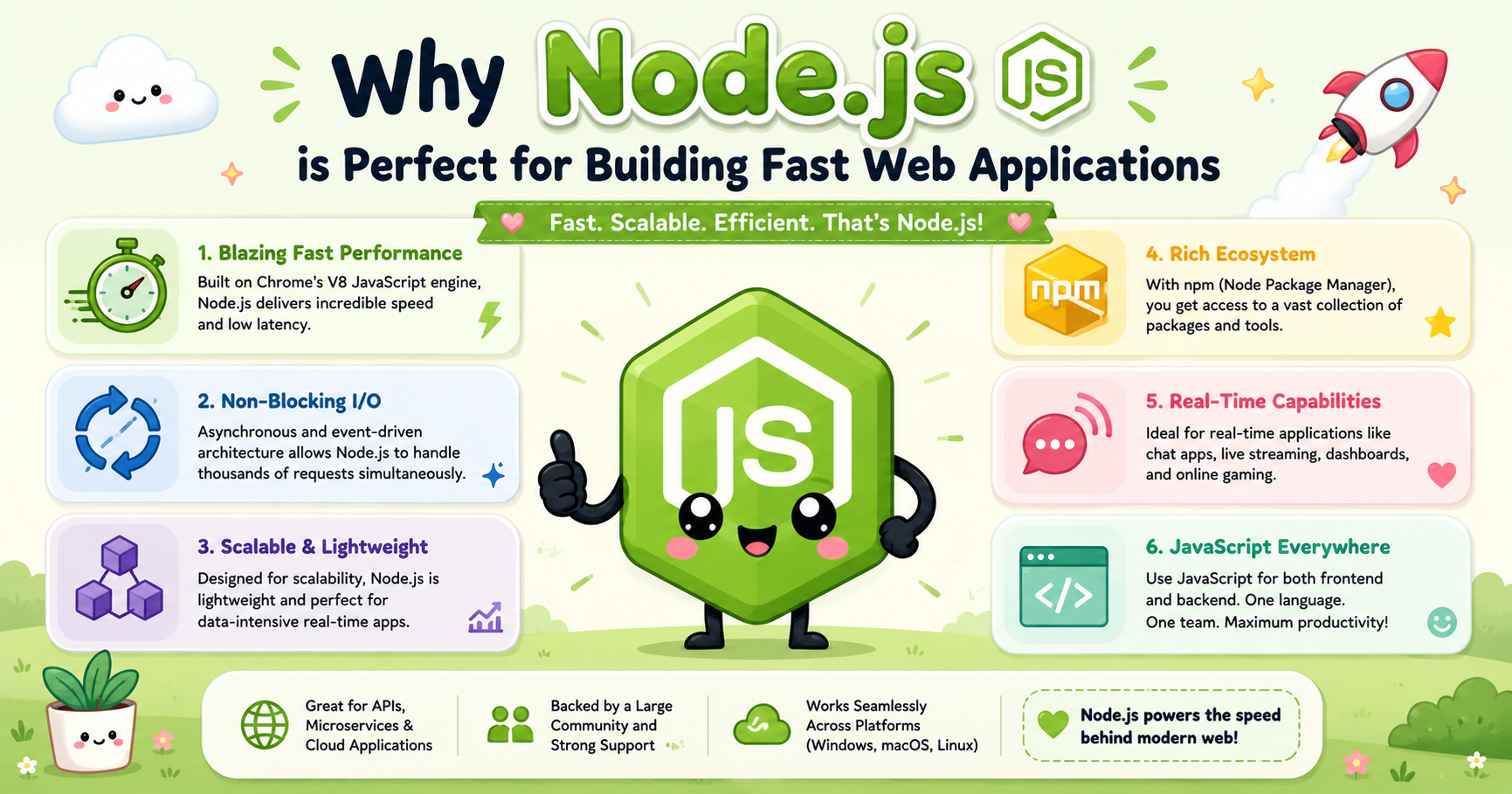
Modern web applications are expected to respond instantly, handle thousands of users at once, and process data in real time. Traditional server technologies often struggle when many requests arrive simultaneously because they rely heavily on blocking operations and thread-based execution models. This is where Node.js stands out.
Node.js became popular because it allows developers to build fast, scalable, and efficient web applications using JavaScript on the server side. Companies building chat systems, streaming platforms, APIs, dashboards, and real-time collaboration tools often choose Node.js because of its performance and lightweight architecture.
This article explains why Node.js performs so well, how its architecture works, and where it delivers the best results.
What Makes Node.js Fast
The speed of Node.js comes from several design decisions working together rather than one single feature.
At its core, Node.js uses the V8 JavaScript engine developed by Google for the Chrome browser. V8 converts JavaScript into highly optimized machine code before execution. Instead of interpreting JavaScript line by line, it compiles the code into instructions the computer can execute efficiently.
This significantly improves runtime performance.
Another major reason is that Node.js avoids creating a new thread for every user request. Traditional web servers often allocate separate threads for each connection. That approach consumes memory and CPU resources very quickly when traffic increases.
Node.js handles requests differently. It uses an event-driven and non-blocking model that can process many operations simultaneously without constantly creating additional threads.
The result is:
Faster response handling
Lower memory consumption
Better scalability under high traffic
Efficient handling of concurrent users
This makes Node.js especially effective for applications where many users interact with the server at the same time.
Understanding the Non-Blocking I/O Concept
One of the most important concepts behind Node.js performance is non-blocking I/O.
I/O stands for Input/Output operations such as:
Reading files
Accessing databases
Calling external APIs
Fetching network resources
In traditional blocking systems, the server waits for an operation to finish before moving to the next task.
For example:
User requests data
Server starts reading from database
Server waits until database responds
Only then can it continue processing
This waiting wastes execution time. Node.js works differently.
When an operation like a database query starts, Node.js delegates that task and immediately continues handling other requests. Once the operation finishes, the result is returned through a callback, promise, or async handler.
This means the server remains active instead of sitting idle.
A simplified flow looks like this:
Request arrives
Node.js starts async operation
Node.js continues processing other requests
Completed operation returns result later
Because of this behavior, a single Node.js server can manage thousands of simultaneous connections efficiently.
This architecture is especially useful for applications with heavy network activity, such as:
Chat applications
Streaming services
Real-time dashboards
Multiplayer games
Live notifications
API gateways


