

Destructuring in JavaScript
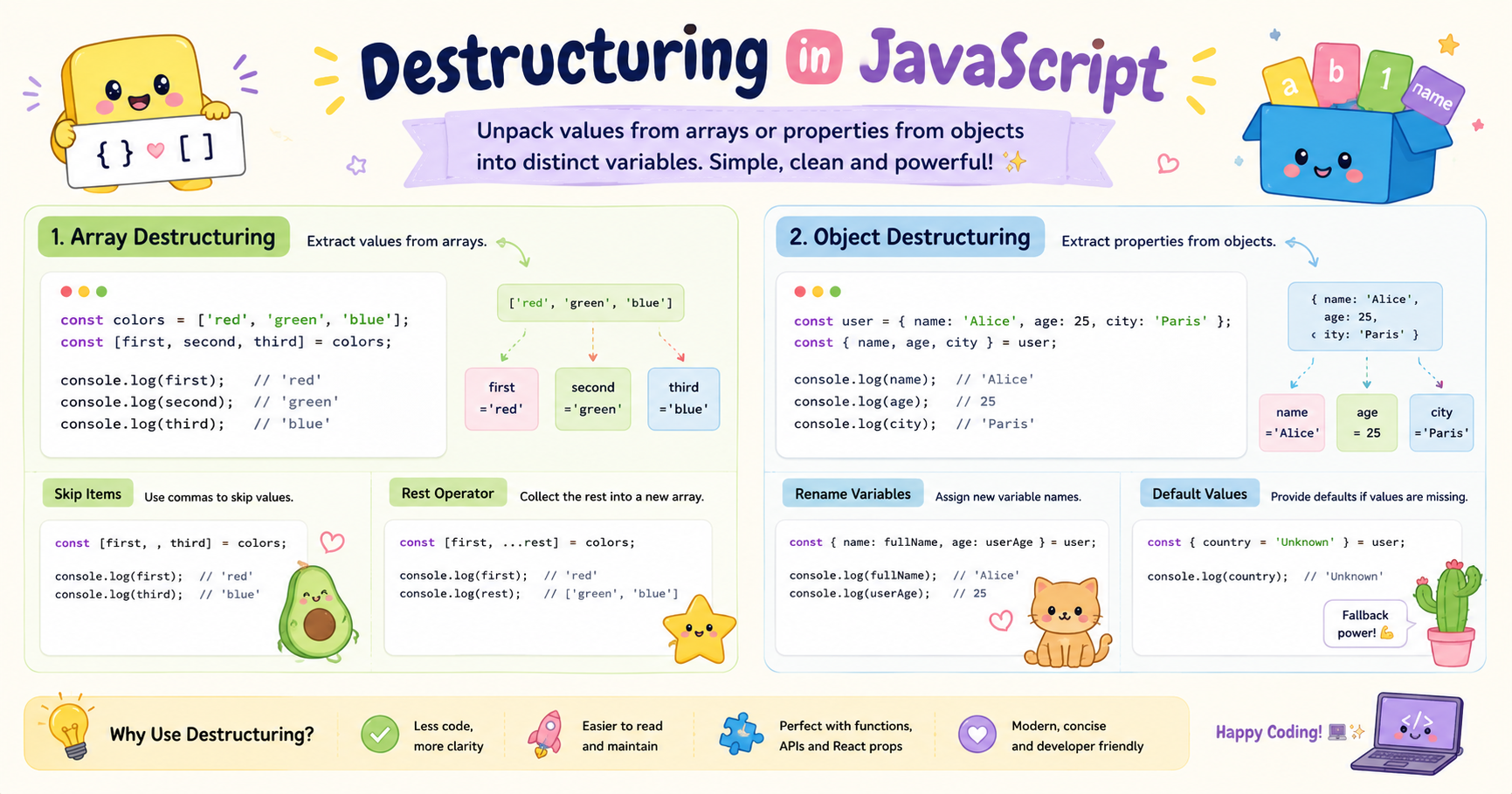
JavaScript developers often work with arrays and objects that contain multiple values. Before modern JavaScript features were introduced, extracting values from these structures required repetitive code. Destructuring solved this problem by providing a cleaner and more readable way to unpack values into variables.
Destructuring is now a common part of modern JavaScript development, especially in React, Node.js, APIs, and functional programming patterns. Understanding it properly helps write shorter, clearer, and more maintainable code.
What Destructuring Means
Destructuring is a JavaScript syntax that allows values from arrays or properties from objects to be extracted and assigned to variables in a concise way. Instead of manually accessing values one by one, destructuring lets you unpack them directly.
Without destructuring:
const user = {
  name: "Pritam",
  age: 22
};

const name = user.name;
const age = user.age;

console.log(name);
console.log(age);
With destructuring:
const user = {
  name: "Pritam",
  age: 22
};

const { name, age } = user;

console.log(name);
console.log(age);
Both approaches produce the same result, but destructuring removes repetition and improves readability. The feature was introduced in ES6 and is widely supported in modern JavaScript environments.
Destructuring Arrays
Array destructuring extracts values based on position.
Consider a simple array:
const colors = ["red", "green", "blue"];
Without destructuring:
const first = colors[0];
const second = colors[1];
Using destructuring:
const [first, second] = colors;

console.log(first);   // red
console.log(second);  // green
The variables receive values according to their order in the array.
Using the Rest Operator
The rest operator collects remaining values into another array.
const fruits = ["apple", "banana", "mango", "orange"];

const [first, ...remaining] = fruits;

console.log(first);      // apple
console.log(remaining);  // ["banana", "mango", "orange"]
This is useful when the first few values are important but the remaining data should still be preserved.
Swapping Variables
Destructuring can swap values without a temporary variable.
let a = 5;
let b = 10;

[a, b] = [b, a];

console.log(a); // 10
console.log(b); // 5
Before destructuring, swapping required extra steps. Now it is simpler and more readable.
Destructuring Objects
Object destructuring extracts values using property names instead of positions.
Example:
const student = {
  name: "Rahul",
  course: "JavaScript",
  duration: "3 months"
};

const { name, course } = student;

console.log(name);
console.log(course);
Here, the variable names must match the object property names.
Renaming Variables
Sometimes variable names should be different from property names.
const product = {
  title: "Laptop",
  price: 50000
};

const { title: productTitle, price: productPrice } = product;

console.log(productTitle);
console.log(productPrice);
Nested Object Destructuring
Objects often contain nested data.
const user = {
  name: "Amit",
  address: {
    city: "Kolkata",
    country: "India"
  }
};

const {
  address: { city, country }
} = user;

console.log(city);
console.log(country);
This avoids repeatedly accessing nested properties manually.
Destructuring in Function Parameters
A very common use case is extracting object properties directly inside function parameters.
Without destructuring:
function displayUser(user) {
  console.log(user.name);
  console.log(user.age);
}
With destructuring:
function displayUser({ name, age }) {
  console.log(name);
  console.log(age);
}
This pattern is heavily used in React components and API handling.
Default Values
Sometimes arrays or objects may not contain all expected values. Destructuring supports default values to handle such situations safely.
Default Values in Arrays
const numbers = [1];

const [first, second = 100] = numbers;

console.log(first);   // 1
console.log(second);  // 100
Since the second value does not exist, the default value is used.
Default Values in Objects
const user = {
  name: "Pritam"
};

const { name, role = "Developer" } = user;

console.log(name); // Pritam
console.log(role); // Developer
If the role property is missing, "Developer" becomes the fallback value.
Benefits of Destructuring
Destructuring became popular because it solves several practical problems in JavaScript development.
Cleaner Code
It reduces repetitive property access and indexing.
Instead of writing:
const username = user.username;
const email = user.email;
const age = user.age;
You can write:
const { username, email, age } = user;
The result is shorter and easier to read.
Better Readability
Destructuring makes the intent of the code clearer.
When reading:
const { title, author } = book;
It is immediately obvious which values are being used.
Easier Function Handling
Functions that receive configuration objects become cleaner.
function createUser({ name, age, country }) {
  console.log(name, age, country);
}
This avoids repeatedly referencing object properties inside the function body.
Useful with APIs
Modern applications frequently work with API responses.
Example:
const response = {
  status: 200,
  data: {
    id: 1,
    username: "pritam_dev"
  }
};

const {
  data: { username }
} = response;

console.log(username);
Destructuring makes extracting API data significantly easier.
Conclusion
Destructuring is one of the most useful features introduced in modern JavaScript. It provides a concise and readable way to extract values from arrays and objects while reducing repetitive code.
Array destructuring works based on position, while object destructuring works based on property names. Features like default values, nested destructuring, renaming, and rest operators make it flexible enough for real-world applications.
Today, destructuring is deeply integrated into modern JavaScript development, especially in React applications, API handling, Node.js backends, and functional programming patterns. Learning it properly improves both code quality and developer productivity.


